

Key Highlights
- ACP, UCP, AP2, x402, MPP, TAP and Visa Intelligent Commerce (VIC) are common agentic protocols within the agentic commerce space. Their coverage overlaps. We map each protocol across four parts of a purchase, from catalog and checkout to settlement.
- Specifications run ahead of live checkout. UCP checkout is available only to select merchants, and OpenAI now lets merchants use their own checkout while it focuses on product discovery.
- Some platforms support several at once: Stripe supports both MPP and x402, and UCP offers an AP2 mandates extension that adds signed user authorization to a checkout.
- The protocols are still developing; their maturity differs as of October 2026: The ACP README calls its specification beta, and MPP states no specification version.
Introduction
Six protocols now cover agentic commerce: ACP, UCP, AP2, x402, MPP and Visa Intelligent Commerce. Visa's Trusted Agent Protocol (TAP) sits beside VIC and appears in the comparison too. The short answer is that agentic commerce protocols mostly complement each other, and their coverage overlaps. In our reading, each protocol mainly covers one or two parts of a purchase: catalog and checkout, trust and consent, payment credential, or settlement. Five of the six touch more than one part. ACP and UCP both mainly cover catalog and checkout, and ACP, AP2, x402, MPP and VIC each mainly cover the payment credential.
In this piece, we compare ACP, UCP, AP2, x402, MPP and VIC on job, maintainers and users, payment rail and maturity.
What are agentic commerce protocols?
Agentic commerce protocols are standards that define how AI agents and businesses complete purchases on a person's behalf.
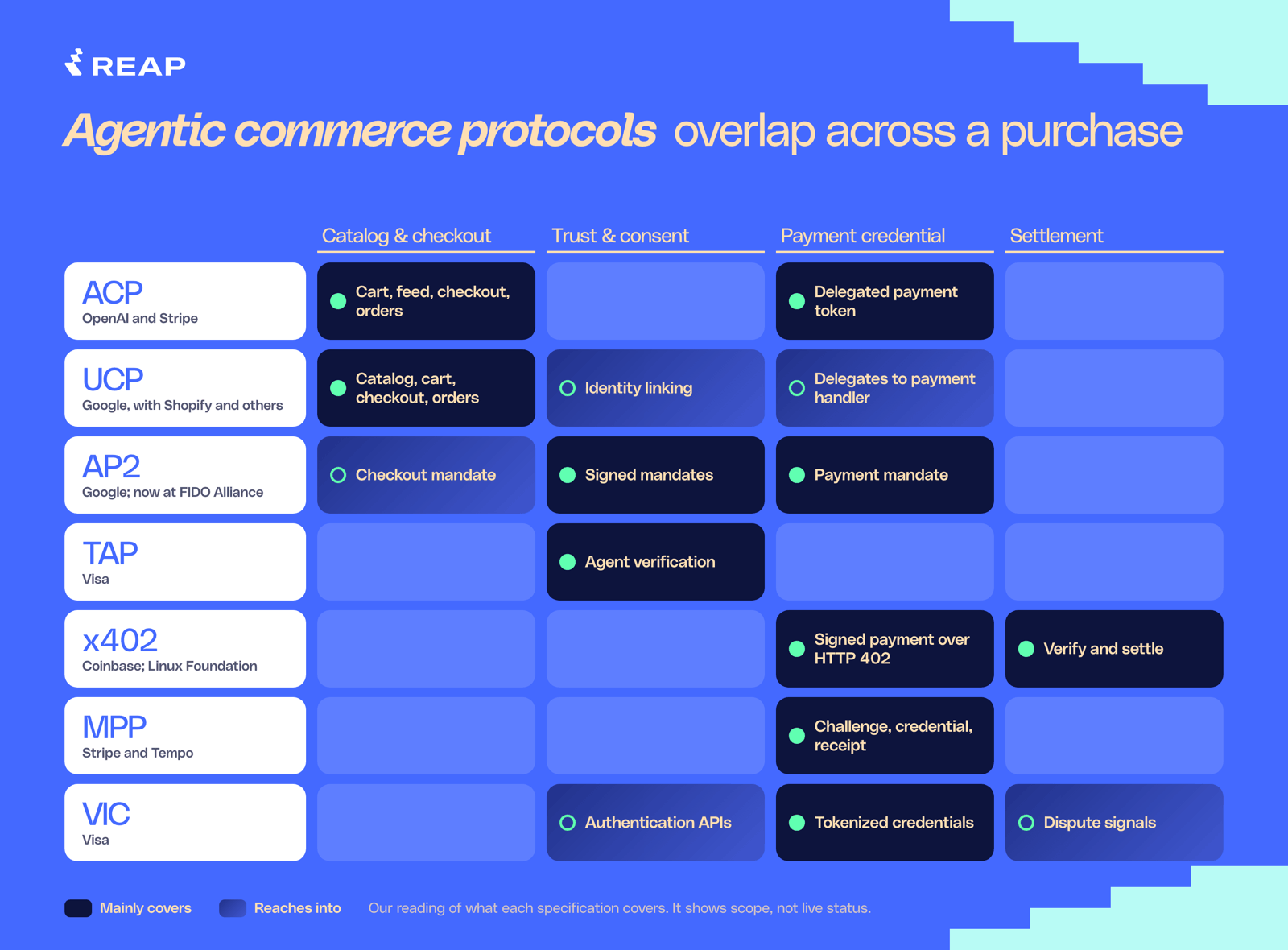
In today's landscape, no single protocol covers an entire purchase end-to-end, from discovering a product to authorizing spend and actual checkout. The coverage grid above shows the same thing: each protocol has its own specializations that can span more than one part of a purchase, but none covers the entire process. Teams that want the wider picture can start with our guide to how AI agents pay online.
How do the agentic commerce protocols compare?
The six agentic commerce protocols, plus Visa's Trusted Agent Protocol, cover overlapping parts of a purchase, and the grid above shows where. A solid cell marks the part a specification mainly covers, and an outlined cell marks a part it reaches into. The table compares them by job, maintainer, payment rail and status.
The grid shows that certain protocols can do more than one job: ACP covers both checkout and the delegated payment token. UCP hands payment to a payment handler and adds AP2 mandates when both sides negotiate them. AP2 reaches into catalog and checkout through its Checkout Mandate and covers the payment credential through its Payment Mandate.
Which protocols cover catalog and checkout?
ACP and UCP mainly cover catalog and checkout, the part of a purchase where an AI agent finds a product, builds a cart, checks out and tracks the order. Both specifications describe catalog or cart, checkout and order handling. ACP also mainly covers the payment credential, through its delegated payment token, explained in the payment credential section. OpenAI and Stripe maintain ACP, and Google announced UCP with co-developers. Live checkout is narrower than the specifications describe, as the next two sections show.
What is the Agentic Commerce Protocol (ACP)?
The Agentic Commerce Protocol is an open standard that lets buyers, their AI agents and businesses transact with one another. In gist, Stripe's documentation lists five building blocks.
- Cart and feed: merchants share a structured product feed so their products can appear in ChatGPT.
- Agentic checkout: the agent checks out with the business.
- Delegate payment: a one-time token scoped to a merchant, a maximum amount and an expiry lets the merchant's payment provider charge, per the delegate payment RFC.
- Delegate authentication: a merchant-named provider authenticates the cardholder through 3DS2 in the browser, and the RFC defines no record of the user's consent, per the delegate authentication RFC.
- Orders: the business sends order updates by webhook.
OpenAI and Stripe maintain and jointly govern ACP, with Meta being mentioned as a joint creator of the protocol.
According to OpenAI's March 2026 announcement, ACP now powers product discovery in ChatGPT, where merchants share product feeds and promotions. The first Instant Checkout version fell short of the flexibility OpenAI wanted, so merchants now run their own checkout. Retailers including Target, Sephora and Wayfair have integrated ACP for discovery.
The ACP README names ChatGPT and other agent surfaces for OpenAI's implementation, and OpenAI's developer documentation says merchants start by sharing a structured product feed to appear there.
What is the Universal Commerce Protocol (UCP)?
The Universal Commerce Protocol is an open standard from Google for the whole shopping journey, from finding a product and buying it through to after-sales support. In gist, an agent searches a catalog, builds a cart, links the user's identity, checks out and tracks the order, and the payment step goes to a payment handler such as Google Pay or Shop Pay, with AP2 mandates added when both sides negotiate them.
Google announced UCP in January 2026 with Shopify, Etsy, Wayfair, Target and Walmart as co-developers. UCP would soon power checkout for eligible listings in AI Mode while Google's Merchant Center help now allows UCP checkout to select merchants and requires merchants to apply to an early access program and complete the technical implementation.
In mid-October 2026, Google began rolling out Universal Cart in the US across Search and the Gemini app, where checkout is powered by UCP and the merchant remains the seller of record. Up next, a draft specification extends UCP to lodging. The UCP site marks food specifications as coming soon.
What is the difference between UCP and ACP?
UCP and ACP both mainly cover catalog and checkout, so UCP vs ACP comes down to four differences and one open question.
- Maintainers: ACP comes from OpenAI and Stripe, and Google announced UCP with co-developers.
- First surfaces: The ACP README names ChatGPT and other agent surfaces for OpenAI's implementation. Google's posts place UCP in AI Mode and the Gemini app.
- Payment step: ACP defines its own delegated payment token. UCP hands payment to payment handlers such as Google Pay and Shop Pay.
- Checkout today: UCP checkout is limited to select merchants in early access, and ACP merchants use their own checkout while OpenAI focuses on discovery.
- Open question: Neither the UCP site nor the ACP README states how the two protocols relate. None of the sources we read says one replaces the other.
Which protocols cover trust and consent?
AP2 and Visa's Trusted Agent Protocol mainly cover trust and consent.
- AP2 by Google records what a user authorized an agent to buy
- Trusted Agent Protocol by Visa helps merchants tell legitimate AI agents from malicious bots.
- AP2 also mainly covers the payment credential, through its Payment Mandate, explained in the payment credential section.
What is the Agent Payments Protocol (AP2)?
The Agent Payments Protocol is an open protocol from Google that records what a user authorized an agent to buy. In gist, the AP2 site describes two signed mandates.
- Checkout Mandate: a signed record of the cart the user approved, with the items and terms agreed between agent and merchant.
- Payment Mandate: a signed approval to pay with one specific payment method, shared with the networks and the payment processor.
Google created AP2. In April 2026, the FIDO Alliance announced that Google had contributed AP2 and Mastercard had contributed Verifiable Intent, and FIDO created working groups for agentic authentication and for payments.
A user can cap what an agent spends and limit which payment methods it may use, then let it buy without asking each time.
What is Visa's Trusted Agent Protocol (TAP)?
The Trusted Agent Protocol is a Visa framework, distinct from Visa Intelligent Commerce, that lets merchants recognize trusted AI agents and tell them apart from malicious bots. Each agent uses its own cryptographic signature to show that it intends to buy. The signature can also show whether the consumer already has an account with the merchant, and agents may attach payment details. Visa unveiled it on 14 October 2025, developed with Cloudflare and with early input from partners including Adyen, Coinbase, Microsoft, Shopify and Stripe. TAP is used in a first live pilot with BILL and Billtrust, for card payments of business invoices through supplier portals. BILL's payment agent pays invoices its customers have already approved, and Billtrust's portals use TAP to authenticate that agent.
How do TAP and AP2 differ?
TAP and AP2 both mainly cover trust and consent, and they answer different questions. The Trusted Agent Protocol addresses who an agent is: a merchant uses the agent's cryptographic signature to tell it from a malicious bot. AP2 records what a user approved: signed Checkout and Payment mandates.
Which protocols cover the payment credential?
Five protocols mainly cover the payment credential:
- ACP does so through its delegated payment token, described in the catalog and checkout section
- AP2 through its Payment Mandate, described in the trust and consent section.
- x402, MPP and VIC are the three built mainly around it.
- x402 and MPP work over HTTP: a server answers an unpaid request with HTTP 402, and the client retries with payment.
- VIC supplies a tokenized card credential on the Visa network. x402 also covers settlement, because the server or a facilitator verifies and settles the payment.
What is the x402 protocol?
x402 is an open payment protocol that lets a server charge for a request over HTTP 402. In gist, a server answers an unpaid request with HTTP 402 and its payment requirements, and the client retries with a payment payload. The server then verifies and settles the payment, directly or through a facilitator, before it returns the resource. The x402's own repository has more on the flow.
Coinbase created x402, and the x402 Foundation at the Linux Foundation governs it.
x402 is blockchain-agnostic. It lists EVM-compatible (Ethereum Virtual Machine) chains and Solana among its supported networks, and names stablecoin payments as the main use case. Coinbase's documentation lists content paywalls, metered data and agent tool calls as examples.
TRM Labs measured about $52.7 million across 198.9 million x402 settlements since May 2025, and about $25.6 million remains after it filters out self-payments and concentrated flows.
What is the Machine Payments Protocol (MPP)?
The Machine Payments Protocol is an open standard for agent-to-service payments that uses HTTP 402. In gist, the MPP site describes a three-part exchange.
- Challenge. The server issues a challenge that states what a resource costs and which method to use.
- Credential. The client returns a payment credential.
- Receipt. The server confirms payment with a receipt in the Payment-Receipt header.
Stripe and Tempo co-authored MPP. Stripe's documentation says cards run through Shared Payment Tokens, so MPP accepts cards as well as stablecoins.
How do x402 and MPP differ?
The same HTTP 402 pattern runs through x402 and MPP, with different stewards and payment menus. Both answer an unpaid request with a 402 response and accept a retry that carries payment.
- Stewards: The Linux Foundation hosts the x402 Foundation. Stripe and Tempo co-authored MPP.
- Rails: x402.org names stablecoins as its primary use case. Stripe's MPP documentation lists cards through Shared Payment Tokens beside stablecoins.
What is Visa Intelligent Commerce (VIC)?
Visa Intelligent Commerce is Visa's initiative for AI agents that find and buy on behalf of consumers. Visa introduced it on 30 April 2025 at its Global Product Drop and, in its launch release, said it "enables AI to find and buy." The release lists tokenized digital credentials that replace card details, authentication APIs, consumer-set spending limits and conditions, and commerce signals shared in real time with Visa to help it manage disputes.
In December 2025 Visa reported more than 100 partners in Visa Intelligent Commerce and "hundreds of controlled, real-world agent-initiated transactions."
Teams that want to understand the risks tokenized credentials address can read our piece on the risks of giving an AI agent a card number. The Trusted Agent Protocol, covered in the trust and consent section, is a separate Visa protocol.
Can a platform support more than one agentic commerce protocol?
A platform can support several agentic commerce protocols, and Stripe already does. Stripe's launch post says Stripe supports both MPP and x402 and lists ACP in its agentic infrastructure. The UCP site names Stripe among its co-developers and offers an AP2 mandates extension, and the AP2 site links an integration guide for UCP.
In our reading of the specifications, the part of a purchase a team works on decides which protocols it should read first. A merchant platform starts with ACP and UCP for catalog and checkout. A service that charges agents per API call starts with x402 and MPP for the payment credential. A card network starts with VIC for card credentials.
How do x402 and AP2 differ?
x402 vs AP2 compares two protocols that cover different parts of a purchase. x402 settles a payment: a server asks for payment over HTTP and the client pays. AP2 records authorization: signed Checkout and Payment mandates show what a user allowed an agent to buy. The AP2 site shows a sample that uses x402 for the payment step, so a platform can use both.
What is still changing in agentic commerce protocols?
In our reading, the protocols keep changing because agentic commerce is still taking shape. Each protocol in this comparison is either still changing or has no stated formal status as of October 2026. The ACP README calls its specification beta, the FIDO Alliance working groups are still standardizing AP2, and the MPP site states no specification version. Outside this comparison, Sierra and Meta announced the Personal Agent Protocol on 6 October 2026, an open standard for how personal AI agents work with businesses, and Sierra lists payments as a possible later extension.
How Reap does Agentic
Reap's Agentic Payments lets teams enable safe, controlled agentic payments for their users. An agent can pay at supported merchants, with spend bounded by policy and card data never exposed to the model.
Reap provides the safe-spend layer behind the credential:
- Tokenized credentials per agent, so an agent never holds a raw card number.
- Programmable spend controls, so an agent transacts only within the rules its user set.
- Passkey authentication, so consent stays with the user.
KYB, KYC and network-level authorization sit at Reap's platform layer, and the client stays out of PCI scope. On protocol support, Reap is protocol-agnostic by design: it works with UCP, Visa's Trusted Agent Protocol and VIC today, and other protocols are absorbed as they mature.
Teams that need a card programme behind the credential an agent pays with can read about Reap's Agentic Payments infrastructure.
Conclusion
In our reading, a team choosing where to start should first decide which part of a purchase it works on, from catalog and checkout to settlement. Because coverage overlaps and platforms already support several protocols at once, the first choice does not lock a team out of the rest. Teams that want concrete scenarios can continue with our guide to agentic commerce use cases.
Disclaimer
The information provided in this material is for general informational purposes only and does not constitute legal, financial, tax, or business advice. It should not be interpreted as a recommendation, offer, solicitation, or inducement to engage with Reap's products or services. Any use of Reap's services is at the user's sole risk and discretion.
Reap makes no representation or warranty, express or implied, regarding the accuracy, completeness, or reliability of the information provided. Services are governed exclusively by Reap's applicable legal agreements. Service availability, features, and eligibility may vary by jurisdiction and are subject to regulatory, card network, and operational limitations.
All trademarks, logos, and brand names are the property of Reap and/or their respective owners. References to third-party platforms or services are for descriptive purposes only and do not imply endorsement, partnership, or affiliation.
Reap's services and information are provided on an "as is" and "as available" basis, without warranties of any kind. Reap shall not be liable for any loss or damage arising from the use of, or reliance on, this information or its services.


