
Key Highlights
- A stablecoin card program can use several blockchains at once. The chain affects how funds get into the program, not how the card is used.
- Faster finality makes funds spendable sooner. Reap credits a top-up once the transaction is final on-chain and has passed validation.
- In External authorization mode, the issuer's system has 1.6 seconds to approve each transaction, so any on-chain balance check has to fit inside that window.
- Reap supports Base, Polygon and Solana for user-funded programs, and Ethereum, Polygon and Solana for program-funded master collateral accounts. Monad support has been announced.
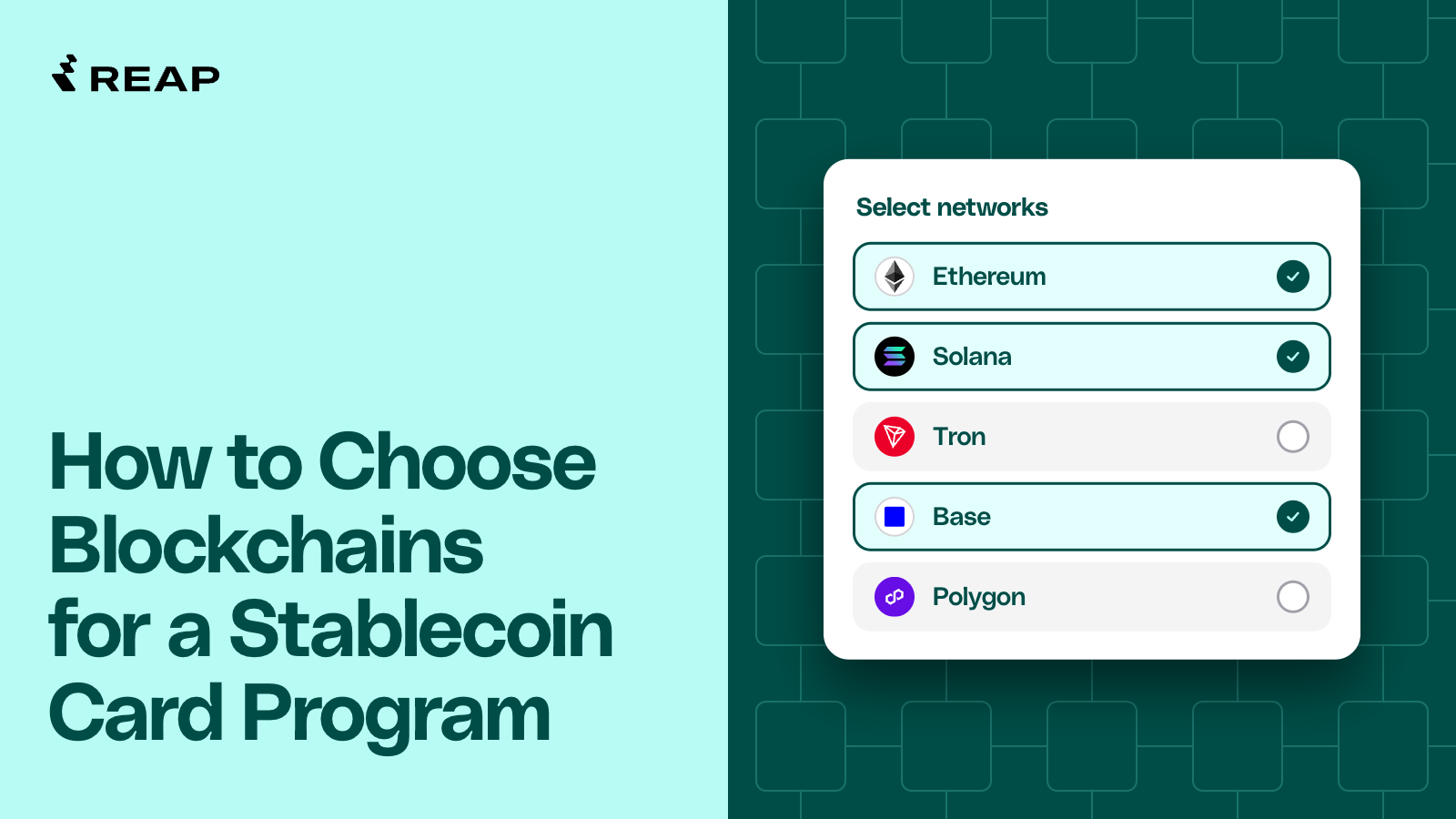
A stablecoin card program can run on more than one blockchain. The chain decides how stablecoins reach the program and how quickly they become spendable. The card side, from authorization to settlement with Visa, works the same whichever chain the funds came from.
This guide covers what the chain changes, how card authorization works, when transaction finality matters, and what to compare before you enable a network.
What does the blockchain change in a stablecoin card program?
The blockchain changes how money gets into a card program, not how the card is used. Four things depend on it:
- How quickly funds become spendable. A transfer that could still be reversed is risky to spend against, so card programs usually count funds as available only once the transaction is final. The sooner a chain reaches finality, the sooner a top-up can be used.
- What it costs to move funds. Every blockchain charges its own network fee for each transfer, and fee levels differ from one network to the next. Whoever sends the funds pays it, whether that is a user topping up or a program funding its own account.
- Which stablecoins are available. Each stablecoin issuer decides which blockchains its token runs on, so a stablecoin can be live on one chain and absent from another. A program can only accept the stablecoins that exist on the chains it supports.
- Where users already hold funds. Users who already hold stablecoins on a supported chain can top up directly. On a chain they don't use, they first have to move their funds across, which adds a step and a fee.
How Reap handles this: each Reap program accepts a set of chains. In user-funded programs, every user account gets an address on each of them; in program-funded programs, the master collateral account does. Balances held on different chains are added up into one balance. Reap credits a top-up once the transaction is final on-chain and has passed validation, and top-ups to a master collateral account can carry a fee agreed with Reap. Base supports USDC, while Ethereum, Polygon and Solana support USDC and USDT.
How does card authorization work for stablecoin cards?
Card authorization is the moment the card network asks for a transaction to be approved or declined, inside a tight time window. On Reap's card issuing platform, the program's setup decides who answers:
- User-funded programs: Reap approves against the stablecoins the user has added to their account.
- Program-funded programs in Managed mode (the default): Reap approves against the balances the issuer keeps in sync. A master collateral account in USDC or USDT backs card spend across the program.
- Program-funded programs in External mode: the issuer's own system approves or declines each transaction in real time. Reap waits up to 1.6 seconds for the answer and declines the transaction if none arrives.
In the first two setups, no blockchain transaction happens while the card is being authorized, because the balance is already credited. The funding model and authorization mode are set when the program is set up and cannot be changed after launch.
What is transaction finality, and when does it matter?
Transaction finality is the point at which a blockchain transaction can no longer be reversed. Ethereum's documentation describes a final transaction as one that is part of a block that "can't change without a large amount of ETH getting burned." Each network reaches finality at its own speed.
For a card program, finality matters in two places:
- Top-ups. A transfer that is not yet final could still be reversed, so card programs generally wait for finality before crediting it. That wait is the gap between a user sending stablecoins and being able to spend them, and it is shorter on a chain that finalizes quickly.
- Real-time balance checks. Some issuers check a balance on-chain at the moment the card is used, instead of against a balance credited earlier. Card networks require issuers to confirm funds are available within seconds of a transaction starting, so that check has to finish inside the network's window. A chain's finality time decides whether it can.
How Reap handles this: Reap credits a top-up only once the transaction is final on-chain and has passed validation. In External mode, the issuer's system has up to 1.6 seconds to approve each transaction, so any on-chain check has to fit inside that. Reap's Monad announcement states that the network's 600-millisecond finality lets issuers confirm stablecoin balances within the card authorization window.
What should you compare when choosing blockchains?
You don't have to pick only one chain. Enabling several lets users top up from wherever they hold funds. For each chain you consider, ask:
- How quickly does a transaction become final, and does that suit your top-up flow and authorization mode?
- Which stablecoins does the chain support, and are those the ones your users hold?
- What will it cost your users or your program to move funds on it?
- Does your card issuing provider support the chain for your funding model?
- How are transactions screened? Reap's program-funded setup includes fraud monitoring, KYC and transaction screening.
Which blockchains does Reap support for card programs?
Reap supports different chains for each funding model:
- User-funded programs (stablecoins added to each user's account): Base, Polygon and Solana.
- Program-funded programs (the master collateral account): Ethereum, Polygon and Solana.
Each program accepts a subset of these. Reap has also announced it will add support for Monad, with Meru as the first to launch a card program on that integration. Reap is expanding the list.
Can you add a blockchain later without rebuilding your card program?
Yes, for the chains Reap supports. Reap's API tells an integration which chains and stablecoins each address accepts, so they don't need to be hard-coded. Reap's card infrastructure handles authorization, processing, compliance and operations, so a new chain adds a funding option rather than a new card stack.
As Daren Guo, Co-Founder of Reap, put it: "Card issuers need to build on whichever network fits their users, and our job is to make that possible without them rebuilding their programs from scratch."
Two things stay fixed after launch: the funding model and the authorization mode. Issuers who need a chain Reap doesn't list yet can ask their Reap contact.
To launch a stablecoin card program on these chains, explore Reap's card issuing feature.
Disclaimer
The information provided in this material is for general informational purposes only and does not constitute legal, financial, tax, or business advice. It should not be interpreted as a recommendation, offer, solicitation, or inducement to engage with Reap’s products or services. Any use of Reap’s services is at the user’s sole risk and discretion.
Reap makes no representation or warranty, express or implied, regarding the accuracy, completeness, or reliability of the information provided. Services are governed exclusively by Reap’s applicable legal agreements. Service availability, features, and eligibility may vary by jurisdiction and are subject to regulatory, card network, and operational limitations.
All trademarks, logos, and brand names are the property of Reap and/or their respective owners. References to third-party platforms or services are for descriptive purposes only and do not imply endorsement, partnership, or affiliation.
Reap’s services and information are provided on an “as is” and “as available” basis, without warranties of any kind. Reap shall not be liable for any loss or damage arising from the use of, or reliance on, this information or its services.


