

Key Highlights
- BIN sponsorship vs card issuing: a BIN sponsor lends the BIN and scheme access and the program runs the rest of the stack, whereas a card issuing platform runs the whole stack.
- Under BIN sponsorship, your team runs the processor, operations and cardholder experience, and the sponsor stays accountable for scheme compliance.
- Under card issuing, a platform usually runs the processor, card production and operations, so you build the product on top.
- BIN sponsorship needs you to bring BIN configuration, a processor connection and card manufacturer setup before the first card, while card issuing needs an integration with the platform's existing program.
- What your team already runs usually decides the route, and AML and KYC/KYB standards apply on both BIN sponsorship and card issuing.
BIN sponsorship vs card issuing comes down to one question: who runs the card stack. Under BIN sponsorship, a card scheme member lets you issue cards under its BIN, and your team runs the processor, the program and the operations. Under card issuing, a platform runs that stack. You build your product on top.
This post compares the two routes by what you build, what you hand over, and what each takes before the first card goes live.
What is the difference between BIN sponsorship and card issuing?
BIN sponsorship and card issuing differ in who owns the stack behind the card. A BIN sponsor is a card scheme member that lets another company issue cards under its BIN, and it takes on the regulated responsibilities that come with the BIN. The BIN is the first six to eight digits of a card number, and it identifies the institution that issued the card. A card issuing platform provides the stack itself, usually including the processor, card production, program operations and risk tooling.
As a general industry practice, the split usually looks like this:
Terms differ by provider, so confirm each row before you commit. For the model in depth, see what BIN sponsorship is.
What do you build and run under BIN sponsorship?
Under BIN sponsorship, your team builds and runs everything between the BIN and the cardholder. It usually acts as the program manager, which designs the card, sets the user experience and owns the customer relationship. A processor connection, a card manufacturer relationship and identity verification usually sit on your side too.
The sponsor takes on the regulated responsibilities that come with the BIN. You control the processor and the cardholder experience, and you carry the cost of running them.
What does a card issuing platform run for you?
A card issuing platform usually runs the processor, card production, program operations and risk controls for you. You integrate with its API and onboard your customers through its flow. The platform handles the rest of the stack behind the card.
You give up some control to the platform's standard setup. Your team spends its time on the product around the card, such as the app, the customer journey and the use case, and the platform usually makes and ships the cards and watches transactions for fraud.
What has to happen before the first card goes live on each route?
Before the first card goes live, BIN sponsorship needs BIN configuration, a processor connection and card manufacturer setup, while card issuing needs an integration with the platform's existing program.
What does BIN sponsorship need before launch?
- Commercial and compliance review. The sponsor verifies your business, checks that your program fits its risk appetite and commercial terms, and finalises the card network's approval for the program.
- BIN configuration. The card network configures the BIN for your program, including card-not-present, card-present, tokenisation and wallets, and then activates it.
- Technical setup. You connect your processor, set up your card manufacturer and configure card profiles.
- Testing. You test end to end, from authorisation through to settlement.
- Launch. You issue your first cards.
What does card issuing need before launch?
- Business verification and approval. The platform verifies your business and finalises the card network's approvals for your program.
- Integration. You connect to the platform's API against its existing approved program.
- Testing. You test the card flows you plan to offer.
- Launch. You issue cards, and the platform produces and ships physical cards.
Timelines vary by provider and market, so ask each provider for its own estimate.
Which route fits your team?
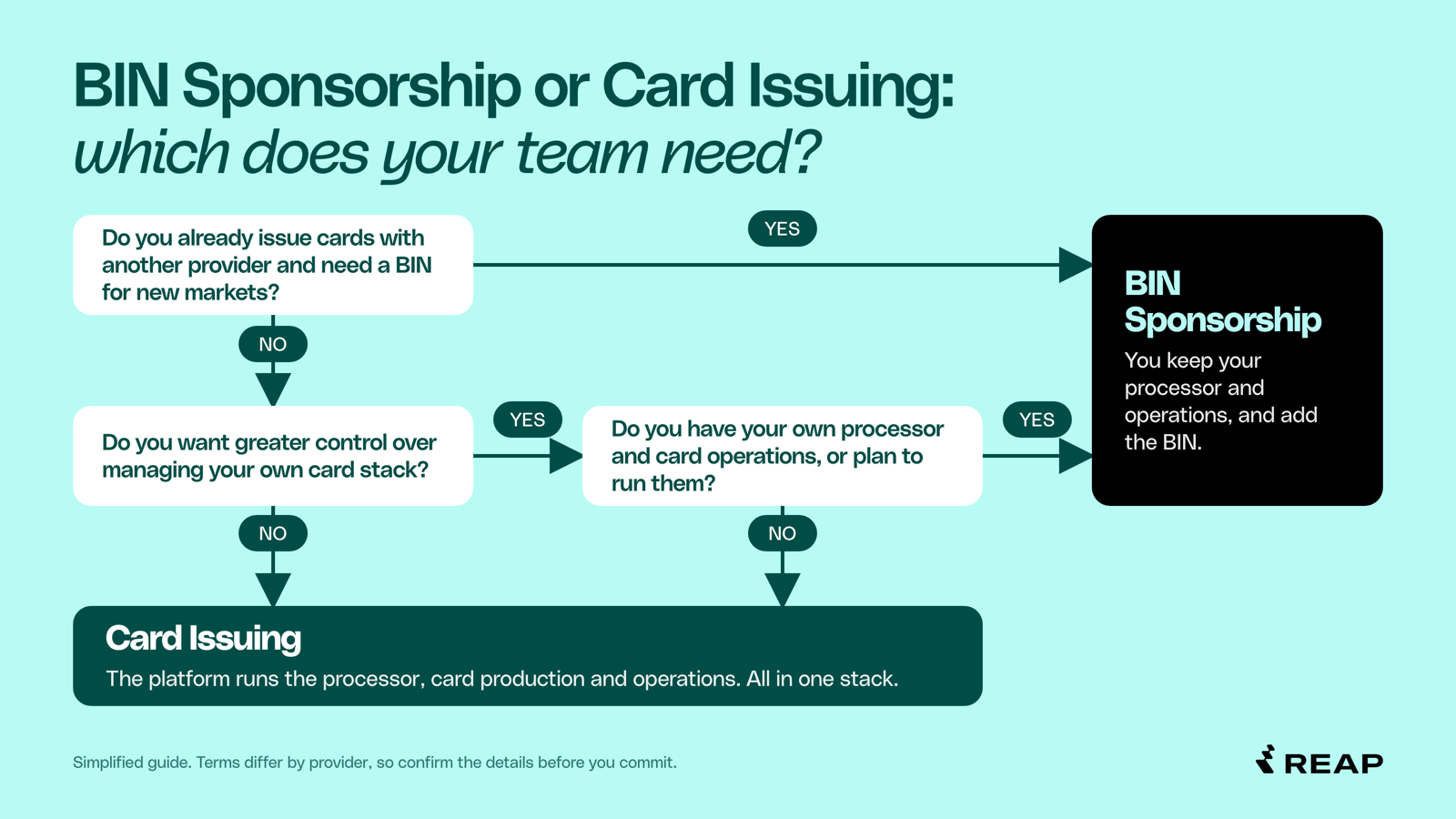
What your team already runs, and how much of the card stack you want to manage, usually decides the route, as the three cases below show.
- If you already issue cards with another provider and need a BIN for new markets, BIN sponsorship adds the BIN and the network relationship without changing the rest of your stack.
- If you want greater control over managing your own card stack, and you run or plan to run your own processor and card operations, BIN sponsorship fits.
- If you have no processor and no card operations, or would rather the platform run them, card issuing fits.
What stays the same on both routes?
On both routes, AML and KYC/KYB standards apply.
A card scheme member stays accountable to the card network for the program. Before you sign with any provider, ask for a written split of who owns verification, disputes, fraud monitoring and reporting.
How can Reap help?
Reap offers both routes, so you can start on the one that fits your team today.
- Card Issuing is Reap's full-stack program. One integration covers the BIN, the processor, card production, KYC and KYB, fraud monitoring and dispute handling.
- BIN Sponsorship is for teams that run their own processor. Reap provides the Visa BIN and the scheme relationship, handles disputes, and stays accountable for cardholder compliance. Reap is a Visa Principal Issuer in Hong Kong and Mexico, so you issue under its licence without a bank sponsor in between.
Not sure which one fits? Talk to the Reap team about your processor setup, target markets and expected volumes.
New to Reap? Create an account →
Conclusion
BIN sponsorship suits teams that already run a processor and card operations and want control of the program. Card issuing suits teams that want to reach their first card without building that stack. Confirm the split of duties with any provider before you sign.
Disclaimer
The information provided in this material is for general informational purposes only and does not constitute legal, financial, tax, or business advice. It should not be interpreted as a recommendation, offer, solicitation, or inducement to engage with Reap's products or services. Any use of Reap's services is at the user's sole risk and discretion.
Reap makes no representation or warranty, express or implied, regarding the accuracy, completeness, or reliability of the information provided. Services are governed exclusively by Reap's applicable legal agreements. Service availability, features, and eligibility may vary by jurisdiction and are subject to regulatory, card network, and operational limitations.
All trademarks, logos, and brand names are the property of Reap and/or their respective owners. References to third-party platforms or services are for descriptive purposes only and do not imply endorsement, partnership, or affiliation.
Reap's services and information are provided on an "as is" and "as available" basis, without warranties of any kind. Reap shall not be liable for any loss or damage arising from the use of, or reliance on, this information or its services.


