

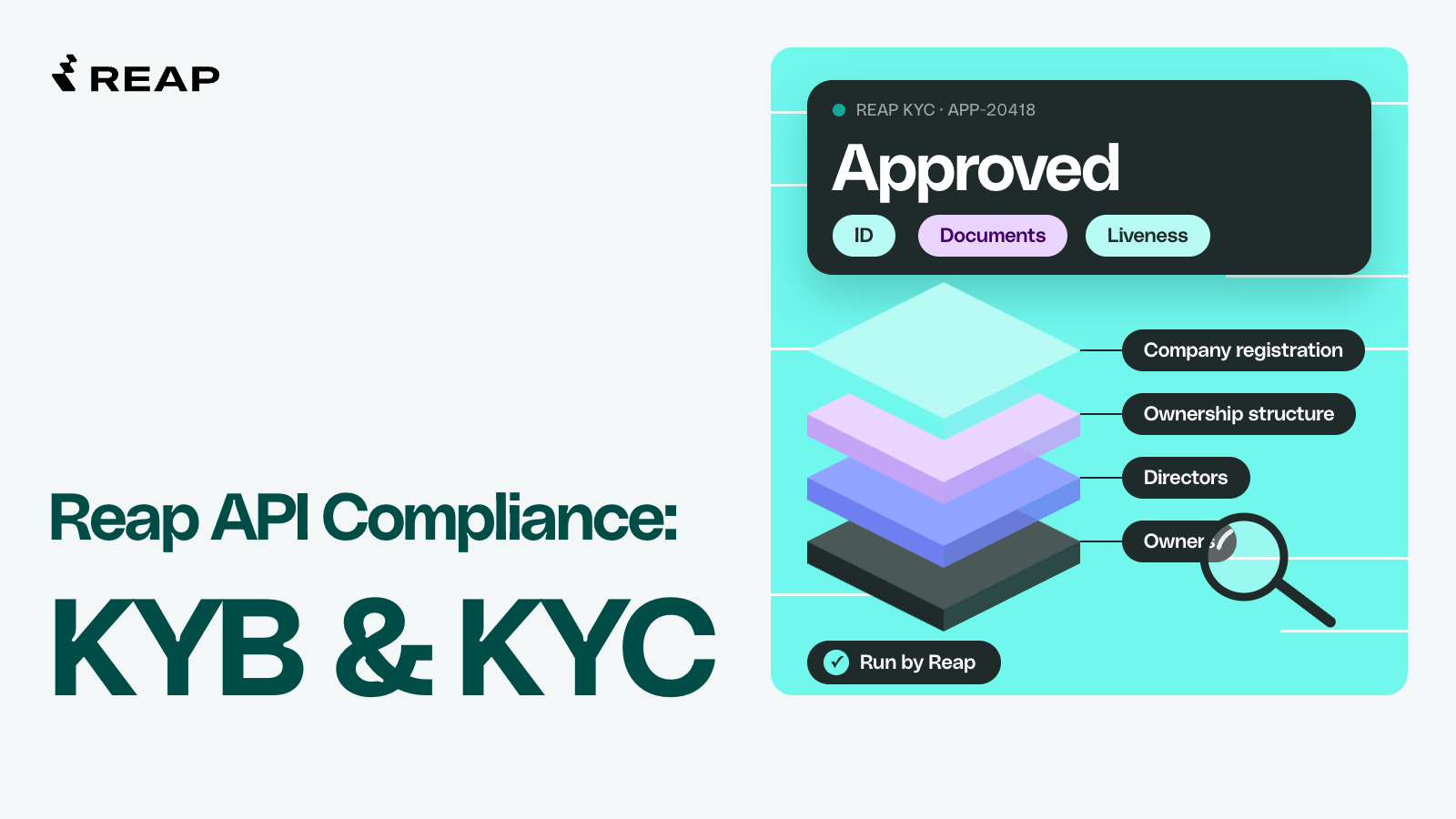
Introducing Reap Compliance Module: KYB and KYC for Card Programs
- Reap API's Compliance module lets a business hand KYB and KYC to Reap, so businesses can launch a compliant card program without building their own verification setup.
- Our KYB and KYC modules run through one integration, allowing a program to verify companies and individuals without separate vendors.
- Reap runs the checks (Managed KYB, Managed KYC) or reviews verifications the program already holds (Universal KYB, Sumsub Token Sharing, Universal KYC), and users who meet Reap's standards do not onboard twice.
- The program owner remains responsible for its own AML and counter-terrorist financing obligations.
What is the Reap API Compliance module?
Reap API Compliance module is the part of Reap API that handles Know Your Business (KYB) and Know Your Customer (KYC) for card programs. It covers verification for card issuing for consumer and corporate programs, and it consists of two modules: KYB, which verifies the companies behind a card program, and KYC, which verifies the individual cardholders.
Setting up KYB and KYC in-house can take months, because a team has to choose providers, collect ID and company documents, and keep up with each country's rules. This module runs the checks, or reviews the verifications you already hold, and blocks cards for anyone not approved. You can launch consumer or corporate cards without building your own end-to-end KYB and KYC setup.
What are the benefits of using Reap’s API Compliance module?
The Reap API Compliance module gives a business four benefits when it launches a card program:
- Faster launch. Reap runs KYB and KYC through one integration, so your business does not need to build its own verification setup before the first card.
- One module for both checks. Reap’s KYB and KYC sit in the same module under Reap API, so your business does not need to stitch together separate vendors for companies and individuals.
- No provider management. We manage the verification provider relationships. We run KYC on Sumsub today, so you do not need your own KYC provider.
- No double onboarding. Reap reviews the KYB and KYC a business has already done, so a company or user who meets Reap's standards does not onboard twice.
AML and counter-terrorist financing obligations stay with the program owner.
How does Reap KYB work?
Reap’s KYB verifies a company by checking its registration and ownership and identifying the directors and owners behind it. A company can hold accounts and issue cards once Reap approves it. Reap KYB offers two methods: Managed KYB and Universal KYB. A program agrees one with Reap at onboarding which method they will use.
What is Managed KYB?
Managed KYB is the method where Reap hosts the verification session. The company's representative completes a form with the registration details and the ownership structure, and each director and owner completes their own identity check. You never touch corporate or identity documents. Reap handles the end-to-end business verification (KYB), and you don't need to build your setup or verify your users yourself. Works best for businesses who haven't started building their compliance stack.
What is Universal KYB?
Universal KYB is the method where a program submits a business pack it has already verified before. The pack holds the registration details, the ownership structure and the supporting documents, and Reap reviews it. Reap approves the company if the pack meets Reap's standards. The company does not onboard a second time. Works best for businesses who have already verified their users and don't want them to undergo the process again, just to get a card.
How does Reap KYC work?
Reap’s KYC typically verifies a cardholder through a government-issued ID, nationality, residential address and a liveness selfie, before the user can hold an account or a card. The exact steps depend on where the user lives and the user's risk profile. Reap KYC offers three methods: Managed KYC, Sumsub Token Sharing and Universal KYC. A program agrees one with Reap at onboarding which method they will use.
What is Managed KYC?
Managed KYC is the method where Reap runs the identity verification. The program embeds a Sumsub verification SDK in its app, and the user completes the checks there. The result arrives by webhook, and the program does not handle the identity documents. Works best for businesses who haven't started building their compliance stack.
What is Sumsub Token Sharing?
Sumsub Token Sharing is the method where a program reuses verifications from its own Sumsub account. The program shares a token for each user, and Reap imports the verification. Reap approves the user if the checks meet Reap's standards. The user does not need to verify a second time. Works best for businesses who have already verified their users and don't want them to undergo the process again, just to get a card.
What is Universal KYC?
Universal KYC is the Reap KYC method where a program submits verifications from its own KYC provider. The program sends the verified data and the supporting documents, and Reap reviews them and returns a decision. Works best for businesses who have already verified their users and don't want them to undergo the process again, just to get a card.
Want to know which model you need? Check out KYB vs KYC comparison
How to get started with Reap KYB and KYC?
A program goes from the first conversation to live verification in three steps:
- Talk to the Reap team. Reap agrees the program mode and the verification method with the program, and both are fixed per program.
- Build in the sandbox. Reap API's Compliance module uses REST endpoints and webhooks like the rest of Reap API, and a program can simulate KYC and KYB outcomes without running a real check. The Reap API documentation covers both flows.
- Go live. You start verifying real users and companies, and Reap blocks cards until the user or company is approved.
Disclaimer
The information provided in this material is for general informational purposes only and does not constitute legal, financial, tax, or business advice. It should not be interpreted as a recommendation, offer, solicitation, or inducement to engage with Reap's products or services. Any use of Reap's services is at the user's sole risk and discretion.
Reap makes no representation or warranty, express or implied, regarding the accuracy, completeness, or reliability of the information provided. Services are governed exclusively by Reap's applicable legal agreements. Service availability, features, and eligibility may vary by jurisdiction and are subject to regulatory, card network, and operational limitations.
All trademarks, logos, and brand names are the property of Reap and/or their respective owners. References to third-party platforms or services are for descriptive purposes only and do not imply endorsement, partnership, or affiliation.
Reap's services and information are provided on an "as is" and "as available" basis, without warranties of any kind. Reap shall not be liable for any loss or damage arising from the use of, or reliance on, this information or its services.


