
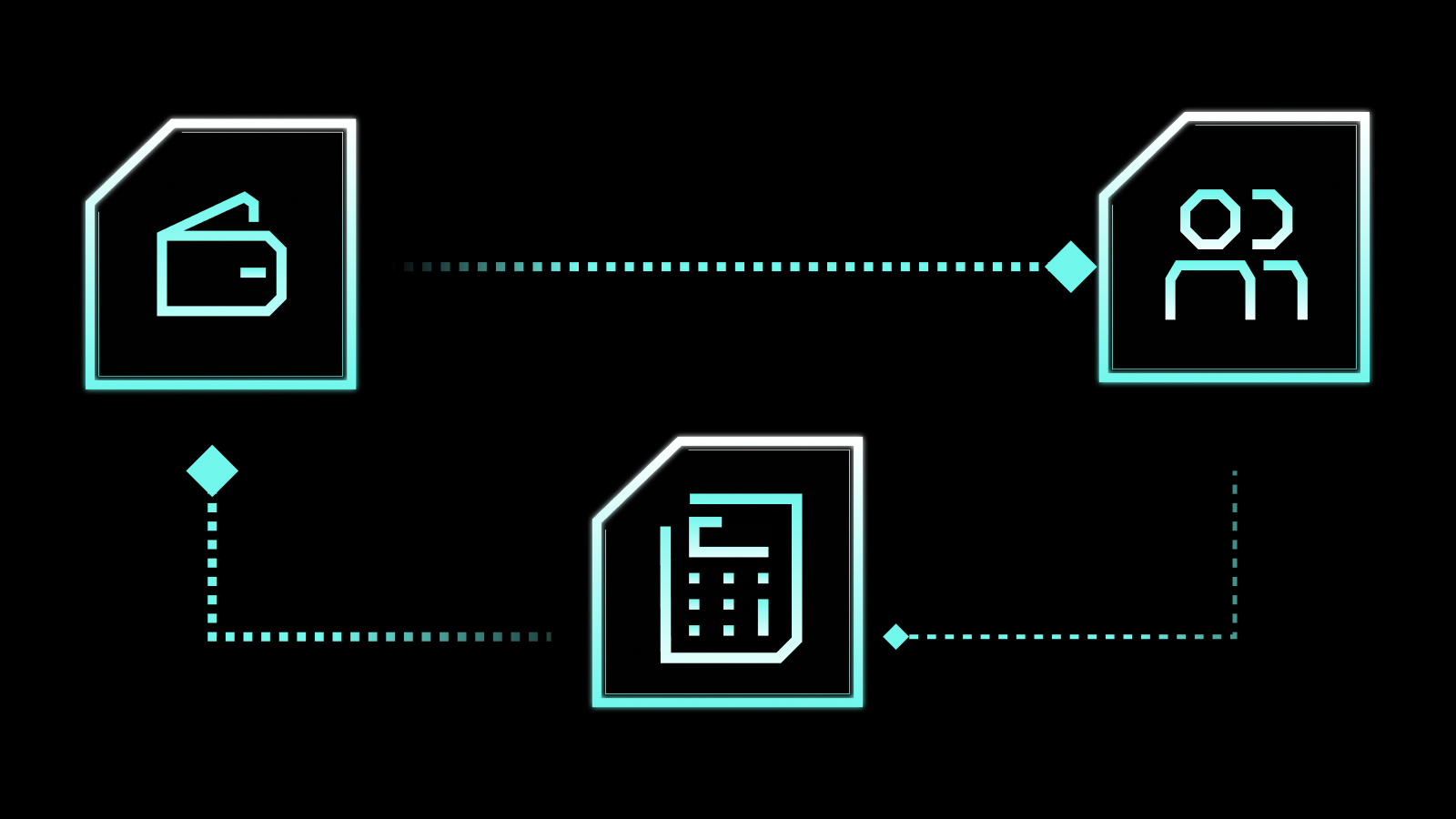
A "financial stack" refers to the set of tools a business uses to manage its money. For a traditional company, this typically includes a bank account, corporate cards, expense software like Expensify, and accounting software like QuickBooks.
This stack works well for managing fiat currency, but it breaks down when a company's treasury is on-chain. The individual components are "crypto-blind"—they cannot connect to, understand, or transact with digital assets. This forces Web3 companies to rely on inefficient, manual processes to bridge the gap between their on-chain treasury and off-chain expenses.
To operate effectively, a Web3 company needs a purpose-built financial stack. This guide breaks that stack down into three logical layers designed for security and efficiency.
A Simple Model for Your Company's Finances
A crypto-native financial stack can be broken down into three distinct layers, each with a specific job and a set of specialized tools.
Layer 1: The Treasury Layer (Where Capital is Secured)
The Treasury Layer is the foundation of your stack. Its purpose is the secure, long-term storage of the majority of your company’s assets, both fiat and digital. This layer prioritizes security above all else.
- Primary Job: Security & Holding.
- Tools: Multi-sig wallets (like Gnosis Safe), institutional custody providers, and cold storage solutions.
Layer 2: The Spend & Operations Layer (Where Capital is Deployed)
This is the active, execution-focused layer of your stack. Its purpose is to take capital from the secure Treasury Layer and deploy it for all day-to-day business spending. It is the command center that connects to the Treasury to deploy capital with speed, control, and visibility.
- Primary Job: Execution & Control.
- The Tool: This is the specific role of the Web3 Business Account.
Layer 3: The Accounting & Reporting Layer (Where Capital is Reconciled)
This is the final layer, where all the transactional data from the Operations Layer is sent. Its purpose is to categorize this data and create a single source of truth for all financial reporting, reconciliation, and bookkeeping.
- Primary Job: Record-Keeping & Reconciliation.
- Tools: Crypto-native accounting software (e.g., Crypto) and traditional platforms (e.g., QuickBooks, Xero) that receive clean, categorized data.
From Treasury to Reporting: A Unified Workflow
The power of this layered model lies in the logical flow of funds and data between components. The workflow is both secure and straightforward:
The workflow is straightforward and secure:
- Capital is held securely in the Treasury Layer.
- An operating budget is moved to the Spend & Operations Layer (the Web3 Business Account).
- All transactions (cards, vendor payments, etc.) are executed and tracked here. The clean, categorized data is then automatically pushed to the Accounting Layer.
In this model, the Web3 business account acts as the critical hub that connects the security of the treasury with the clarity of the accounting system.
The Benefits of a Purpose-Built Stack
Adopting this layered approach provides significant advantages over a fragmented or traditional stack:
- Enhanced Security: Core treasury assets are isolated in a dedicated security layer, minimizing risk from daily operational activities.
- Operational Efficiency: Daily financial tasks are streamlined and automated, saving significant time on manual work.
- Data Integrity: Clean, reliable data flows directly to your accounting system, eliminating manual errors and simplifying reconciliation.
- Scalability: The entire system is designed to scale with the company, as each layer can be optimized independently.
Conclusion
A modern Web3 financial stack is built on three distinct layers: Treasury (hold), Operations (spend), and Accounting (report).
The Web3 business account is the engine of this stack. It is the essential operational hub that transforms a secure digital asset treasury into an efficient and scalable business operation.
—
Your Web3 business operates globally and on-chain. Your financial tools should too. Get started with Reap Direct in minutes:


